What Training Aids Did Scottie Scheffler Use? To win the 2026 FedEx St. Jude Championship

Scottie Scheffler used a putting-led training setup — a Visio putting template, alignment mirrors, the GolfForever fitness system, a grip trainer and a homemade swing-plane drill — to win the 2026 FedEx St. Jude Championship, his 21st PGA Tour title. He closed it out by eight shots at TPC Southwind, his first win since January, and the putter did a huge amount of the heavy lifting all week.
That's the interesting part for us club golfers. Scottie has never been the flashiest putter on Tour, so watching him roll in 15- and 20-footers on his way to a runaway win tells you the practice tools behind the scenes are doing their job. He's clearly changed things up on the greens, so I'm going to do this one a little differently and start with putting before we get to the fitness and full-swing stuff.
Here's the kit I've seen him working with, what each piece actually does, and — where it fits — a version you can use at home.
Putting: where Scottie has made the biggest change
Scottie works on his putting with Phil Kenyon, one of the most respected putting coaches in the game, and a lot of the tools you'll see him using trace back to Kenyon's methods.
The Visio putting template
The one I keep spotting is the Visio Putting Template, designed by Phil Kenyon himself. It's a simple, brilliant bit of kit: you set it down and it lets you groove your face angle and your path through the ball, so you can actually see whether the putter is swinging on the line you think it is. There are putting gates to roll balls through as well, so you get instant feedback on start line.
I use one as a calibration tool. Two minutes on the template — check the path, check the face, roll a few through the gate — and you walk onto the green knowing your stroke is squared away. It's the quickest way I know to reset a stroke that's drifted.
My kit: I'm an affiliate for Visio, so if you want to try one, use code rosse10 for 10% off at visioputting.com. The matching Putting Impact Gates and Putting Gate Pack are on the same link and code if you want the start-line feedback too.
A putting mirror for alignment
Scottie also works with a putting mirror, and I've seen him using the Visio Two-Piece Mirror. A mirror is the single easiest way to sort your eye line and shoulder alignment — two things that quietly wreck more putts than stroke mechanics ever do.
I like the two-piece version specifically because it splits down and slides into your golf bag, so it comes to the course, not just the practice room. The full-size mirrors are great at home but a pain to travel with; the two-piece solves that.
My kit: Same Visio link and code — rosse10 for 10% off at visioputting.com.
The custom "Smart Monkey" mirror (and the at-home version)
At The Open this year I also spotted him using a Smart Monkey putting mirror — a bespoke, made-to-measure mirror produced in partnership with Phil Kenyon, with the reference lines mapped to a specific player's setup. It's a lovely piece of kit, but it's big, custom and priced accordingly — not really an everyday buy for a club golfer.
If you want the same benefit without the bespoke price tag, that's exactly where the
Visio Two-Piece Mirror above comes in — it gives you the alignment and eye-line feedback in something you can chuck in the bag. (To be clear: that's my recommendation as the practical at-home alternative — it's not Scottie's exact custom mirror.)
Reading slope like a pro — for free
You'll see Tour players and coaches using digital green-reading levels — a little digital protractor that reads the slope percentage under the ball. They're genuinely useful for training your eyes to see break, but the good ones run around £100–£150, which is a lot for a practice gadget.
The free workaround I'd point you to: some phone apps now include a putting level that shows you the slope in a percentage and the point you should be aiming at. It's a brilliant way to calibrate your green-reading without spending a penny — check whether your read matches the number, then trust your eyes.
(Ross — flag: I've left the app unnamed because I want you to confirm the exact one you meant, e.g. "Handy Golf," before we publish it as a recommendation.)
A launch monitor for your putter
The last putting piece, and one I think is genuinely clever: I've seen Scottie and Kenyon using a Vertex Golf putting sensor. It's a tiny, feather-light device that clips onto the putter shaft and captures a huge amount of stroke data — face angle, path, tempo, impact — essentially a launch monitor for your putting.
What makes it stand out is the accuracy relative to the price. It stacks up impressively against far more expensive lab systems like SAM PuttLab, it's light enough that it doesn't interfere with the stroke, and you can use it just about anywhere. For the data it gives you, it's remarkable value.
My kit: [Ross — placeholder: there's no Vertex Golf entry in the review tracker, so I can't pull a link or code for it. If you have an affiliate link, drop it in here. No discount code, per your note.]
Fitness: the GolfForever system
Off the course, Scottie is a genuine GolfForever user — he's been a brand ambassador since 2022, and unlike a lot of "sponsored but never touched" deals, there's plenty of footage of him actually using it in the gym and in his warm-ups. It clearly is part of his real routine.
GolfForever is an at-home training system built around flexibility, mobility, core strength and rotational power, with app-guided routines you follow along to. For Scottie I'd guess it's as much a warm-up and movement tool as a strength one — get mobile, get switched on, then layer the heavier gym work on top.
It's the one I'd recommend most widely, and especially to older golfers: it can get you genuinely mobile, it's science-led, and you can do the whole thing at home without a gym membership. If there's one thing on this list most amateurs would actually improve from, it's this.
My kit: I'm an affiliate for GolfForever — code rosseves for 15% off at golfforever.pxf.io/ROSSEVES. This is one of the rare cases where the pro genuinely uses the exact product, not just a lookalike.
Grip: the SuperStroke training grip
Scottie is one of the most fundamentally sound players who's ever lived, and he doesn't leave the basics to chance. I've seen him using a SuperStroke training grip — a moulded grip that shows you exactly where the hands should sit — mostly as a warm-up check to make sure his hold is on correctly before he starts hitting balls.
It's a great reminder that the grip is where every swing starts, and it's the fundamental most amateurs quietly neglect. Building a two-minute grip check into your warm-up the way Scottie does is a cheap, high-value habit.
(Ross — I don't currently carry a grip-placement trainer in the tracker, so there's no affiliate link for this one. Naming it honestly as-is, no alternative forced.)
Full swing: keeping the club in front of him
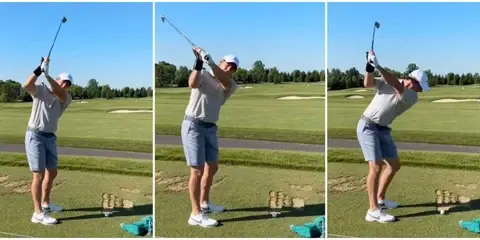
On the range you'll sometimes catch Scottie using a homemade swing-plane trainer — he tapes two Ventus VeloCore shafts together to create a guide that encourages a more upright motion and keeps the club in front of his body through the swing. It's a classic pro hack: cheap, effective, and completely personal to his feels.
Obviously you're not going to tape two premium shafts together. If you want a purpose-built way to train the same idea — keeping the club on line and swinging through on the correct path in front of you — the one I'd point you to is the Tour Aim alignment system. It gives you a proper alignment and path reference every time you practise, so you're grooving the same "stay on plane, stay in front" discipline Scottie is chasing with his shaft rig, without the guesswork. (Again — that's my at-home recommendation, not Scottie's actual kit.)
Tour Aim — 15% off via touraimgolf.com (no code needed, the discount is applied through the link).
Quick reference: Scottie Scheffler's training aids
Area | What Scottie uses | Use-at-home option | Code | Link |
Putting – face & path | Visio Putting Template (Phil Kenyon) | Same | rosse10 (10% off) | |
Putting – start line | Visio Putting / Impact Gates | Same | rosse10 (10% off) | |
Putting – alignment | Visio Two-Piece Mirror | Same | rosse10 (10% off) | |
Putting – custom mirror | Smart Monkey (bespoke) | Visio Two-Piece Mirror | rosse10 (10% off) | |
Green reading | Digital slope level | Free phone putting-level app | — | — |
Putting data | Vertex Golf sensor | Same | placeholder | link TBC |
Fitness | GolfForever system | Same | rosseves (15% off) | |
Grip | SuperStroke training grip | Same | — | — |
Swing plane | DIY twin-shaft trainer | Tour Aim alignment system | no code (15% via link) |
FAQ
What putting aid does Scottie Scheffler use? He works with putting coach Phil Kenyon and uses a Visio putting template to groove face angle and path, alignment mirrors for eye line and shoulder position, and a Vertex Golf sensor to capture stroke data. His putting was a standout in his 2026 FedEx St. Jude Championship win.
Does Scottie Scheffler really use GolfForever? Yes — he's been a GolfForever ambassador since 2022 and genuinely uses the system for warm-ups, mobility and strength work, not just in adverts.
What fitness programme does Scottie Scheffler follow? The core of his at-home work is the GolfForever system, focused on flexibility, mobility, core strength and rotational power, alongside conventional gym training.
Can I use the same training aids as Scottie Scheffler at home? Most of them, yes. The Visio putting tools, GolfForever and a grip trainer are all things any amateur can use at home. For his homemade swing-plane rig, a purpose-built option like the Tour Aim alignment system trains the same on-plane, on-path discipline.
What golf shoes and clubs does Scottie Scheffler use? That's a full "what's in the bag" breakdown in its own right — this piece is focused on his training aids and practice tools rather than his gamer equipment.
Disclosure: some of the links above are affiliate links. If you buy through them I may earn a small commission at no extra cost to you — often with a discount for you. I only ever recommend kit I rate, and I always tell you when a pro's actual gear isn't something I carry.
Author
Ross Eves Msc, Bsc Hons, PGA Professional


Comments