The Training Aids Wyndham Clark Used to Win the 2026 US Open - A PGA Coach's Breakdown

Disclosure: I'm a PGA coach and this post contains affiliate links. If you buy through
them I may earn a small commission at no extra cost to you. I only link kit I actually use with my players - and in this case, kit a US Open champion had on the range.
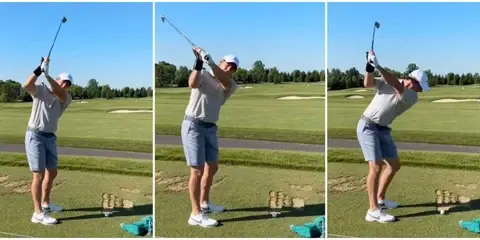
Wyndham Clark just led the 2026 US Open wire-to-wire at Shinnecock Hills to claim his second national title, beating Sam Burns by a shot. Brilliant golf. But if you watched the range at all last week, you'll have spotted the real story: the same training aids in his warm-up, day after day, right up to the win. As a coach that's the bit I geek out over far more than the trophy. So here's what he was using, what each piece actually fixes, and how to know if it's the fix you need.

The problem Clark was actually solving
Clark started working with swing coach Pat Coyner (Director of Instruction at Cherry Hills in Colorado) in late 2025. The public diagnosis was a lead wrist that had crept into too much extension - a "cupped" position at the top - with a backswing that had gone long and an open face. Add those up and you get a steep angle of attack in transition, which is the recipe for a two-way miss. Everything on his range mat was aimed at three things: more width, a stronger trail-wrist condition, and a shallower delivery. That's the lens to view all of this through.
1. The ProSENDR Widener - training width and right-arm structure
The Widener is the newer piece from Sean Foley and David Woods (the same duo behind the original ProSENDR), and it was on Clark's mat all week. Its job is width: stopping the arms and hands collapsing narrow in the backswing.
My coaching take: when a player gets narrow, the trail arm folds early, the club drops behind them, and they're forced to rescue it with hands and timing coming down - usually by getting steep. That's exactly Clark's miss pattern. Training width keeps the trail arm structured and the club more in front of the body, which gives you a wider, more repeatable arc and - the bit amateurs really feel - much better low-point control. If you flush it on the range then flip it on the course, or you're a classic "chicken-winger" through impact, this is the mechanism you're missing.
Who it's for: the player who gets narrow and steep - arms pinching in, club steepening in transition. Who it's not for: if you already swing nice and wide and shallow, you don't need to train more width - this one isn't your fix, so save your money for the piece that is.
Price: $179.99 (RRP $199.99), roughly £140 delivered to the UK. Check the ProSENDR Widener here ->
2. The original ProSENDR (the Cradle) - trail-wrist extension and shallowing
Alongside the Widener, Clark leans heavily on the original ProSENDR wrist cradle. Where the Widener handles the big picture - width and arc - the cradle works the detail at the top: it trains right-wrist extension and a flatter lead wrist, then helps you shallow the club coming down by keeping the back of the trail hand in contact through transition.
My coaching take: this is the direct antidote to Clark's cupped-lead-wrist, steep-transition tendency, and it's the piece I'd hand most amateurs first. Poor trail-wrist structure at the top is one of the most common faults I see, and it's almost impossible to feel your way out of without feedback. The cradle gives you that feedback instantly - you know the second the wrist runs off. Pair it with the Widener and you've got width and the wrist condition working together, which is exactly how Clark uses them.
Price: currently $99.99 on the brand site (RRP $169.99), around £79 on offer. Check the ProSENDR Cradle here ->
3. Alignment and shallowing - the "Tee Drill", and the tool I use for it
The other thing all over Clark's practice station was alignment: rods laid like train tracks so he isn't aiming and swinging too far left, plus a neat trick of teeing the ball up at driver height even when hitting an iron. That's the Tee Drill - named after the golf tee itself - and it forces a shallower, more around-the-body strike, because it's very hard to be steep and chop down on a ball that's teed right up. He also threads an alignment rod through his belt loops as a physical feedback barrier. It looks fussy, but every piece has a job - nothing on that mat is random.
My coaching take: you don't need to copy his exact station, but you do want the same feedback - consistent aim and a shallower path - without spending the whole session fiddling with loose rods that roll everywhere. That's why I set my players up with the Tour Aim. It locks your alignment sticks into a repeatable frame for aim, path and ball position, and doubles as a putting start-line gate. It's the fastest way I've found to build the "train-track" reference Clark's chasing, and it lives in the bag. To be straight with you: I haven't seen a branded Tour Aim in Clark's own setup - this is simply the tool I reach for to train the same fundamentals.
Price: around $95 with alignment sticks ($75 for the base unit), roughly £75-£90 in the UK. Check the Tour Aim here ->
4. The putting side - start line and rolling it on line
Clark rolled it beautifully all week, and a big lead is only worth something if you convert on the greens. On the putting side, everything comes back to two things: aiming the face where you think you're aiming it, and starting the ball on your intended line. That's where I lean on my Visio Putting kit with players, and it's the same gear I use myself:
Visio Template - builds a repeatable setup and a square face at address, so your start line isn't a guess.
Visio T Line - my go-to for start-line work; it gives you instant feedback on whether you've actually rolled it on line or nudged it off.
Visio Elevated String Line - the string overhead is the old-school truth-teller for aim and path; nothing exposes a pull or a push faster.
My coaching take: most amateurs don't have a stroke problem, they have a start-line problem - they aim and launch the ball offline and never see it. Train that and the "makeable" range gets a lot bigger. These are the tools I trust for it.
Price and code: the full Visio range is at Visio Putting, and you can use code rosse10 for 10% off. Browse the Visio putting aids here ->
Do you need to copy a US Open champion?
Honestly? I'd love to say buy the lot - and yes, those are my affiliate links, I'm not going to pretend otherwise. The Widener and the cradle in particular are genuinely brilliant, I use both, and they'd earn their place in most golfers' bags. So no dramatic "don't buy anything" speech here.
The only thing I'll say, coach hat on, is this: a training aid only works when it's fixing the thing that's actually costing you shots. Clark's kit works because it targets his specific fault. Match the tool to your own miss - width, wrist condition, alignment, start line - and any one of these will do serious work. If you're not sure which is yours, that's exactly what a lesson is for, and then you'll know precisely where your money should go. Buy the fix, not just the famous name - and if the fix happens to be what a US Open champion had on his mat this week, even better.
Affiliate disclosure (again, because it matters): the links above are affiliate links. Buying through them supports the site at no cost to you. I only recommend equipment I use in my own coaching.


Comments